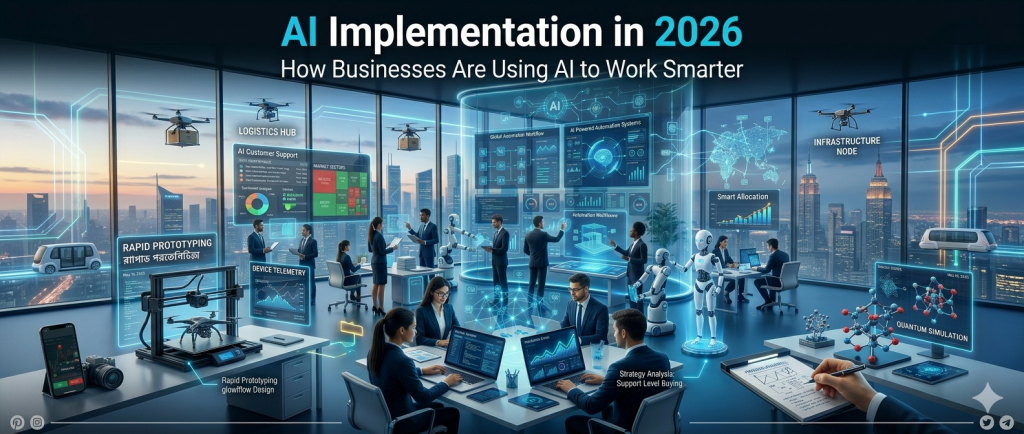
Discover how AI implementation is transforming businesses in 2026. Learn about AI automation, workflow systems, productivity tools, common mistakes, and practical strategies for beginners and modern companies.Lorem ipsum dolor sit amet, consectetur adipiscing elit. Ut elit tellus, luctus nec ullamcorper mattis, pulvinar dapibus leo.
Table of Contents
ToggleIntroduction to AI Implementation
Artificial intelligence is no longer just a futuristic idea discussed by tech companies and scientists. In 2026, AI has become part of everyday business operations around the world.
From small startups to global corporations, businesses are using AI tools to automate repetitive work, improve productivity, save time, and make better decisions.
This process is known as AI Implementation.
The biggest shift happening today is not simply “using AI.” The real transformation comes from implementing AI into workflows, communication systems, marketing processes, customer service, and daily operations.
Companies that understand AI implementation are gaining:
- faster workflows
- improved efficiency
- lower operational costs
- better customer experiences
- stronger digital competitiveness
Meanwhile, businesses ignoring AI are slowly falling behind.
The good news is that AI implementation is no longer limited to programmers or large corporations. Modern AI tools are becoming more accessible, beginner-friendly, and affordable.
In this guide, you will learn:
- what AI implementation really means
- how businesses use AI in 2026
- the best AI productivity systems
- automation strategies
- common mistakes
- beginner-friendly implementation ideas
Whether you are a freelancer, entrepreneur, content creator, or business owner, understanding AI implementation may become one of the most valuable digital skills of this decade.
What Is AI Implementation?
AI implementation means integrating artificial intelligence tools and systems into real business processes to improve efficiency, automation, and decision-making.
Instead of replacing entire businesses, AI usually enhances existing workflows.
For example:
- AI can help customer support teams answer questions faster
- AI writing tools can assist content creators
- AI automation systems can reduce repetitive administrative work
- AI analytics can help companies understand customer behavior
The goal is not simply to “use AI for fun.”
The goal is to create smarter systems that improve productivity and reduce unnecessary manual effort.
This is why AI implementation has become one of the most important business strategies in 2026.
Why AI Implementation Matters in 2026
Technology is moving faster than ever before.
Businesses now face:
- increasing competition
- rising customer expectations
- information overload
- growing operational complexity
Traditional workflows are often too slow to keep up.
AI helps solve this problem.
Companies implementing AI successfully can:
- automate repetitive tasks
- reduce human error
- improve communication
- process information faster
- increase team productivity
This creates a major competitive advantage.
In many industries, AI is no longer considered optional. It is becoming part of modern digital infrastructure.
Businesses that adapt early may gain years of advantage over slower competitors.
How Businesses Use AI Today
AI implementation looks different depending on the industry.
However, several common patterns are emerging across almost all modern businesses.
AI Customer Support Systems
Many companies now use AI chat systems to handle:
- customer questions
- support requests
- appointment scheduling
- FAQs
This allows businesses to provide faster responses without overwhelming human support teams.
AI-powered customer service systems can operate 24/7, improving response time and customer satisfaction.
AI Content Creation
Content creation has become one of the most popular areas for AI implementation.
Businesses now use AI for:
- blog writing assistance
- social media ideas
- ad copy generation
- email marketing drafts
- SEO optimization
Human editing still matters, but AI significantly speeds up production workflows.
This is especially useful for:
- marketers
- bloggers
- affiliate marketers
- freelancers
- eCommerce businesses
AI Workflow Automation
Workflow automation is one of the most powerful forms of AI implementation.
Businesses use AI automation tools to:
- organize tasks
- summarize meetings
- automate reporting
- manage emails
- analyze customer data
Instead of employees spending hours on repetitive administrative tasks, AI systems can complete them within minutes.
This improves efficiency and reduces burnout.
AI Data Analysis
Modern businesses generate enormous amounts of data.
AI systems help companies:
- identify patterns
- predict trends
- analyze customer behavior
- improve decision-making
Instead of manually reviewing spreadsheets for hours, AI tools can process information quickly and provide actionable insights.
Best AI Tools for Automation
Several AI tools are becoming extremely popular in 2026.
AI Writing Tools
AI writing assistants help businesses:
- draft content
- brainstorm ideas
- improve productivity
- accelerate communication
These tools are widely used by:
- bloggers
- agencies
- marketers
- freelancers
AI Meeting Assistants
AI meeting tools can:
- transcribe conversations
- generate summaries
- create action items
- organize notes automatically
This saves significant time for teams and managers.
AI Workflow Platforms
Workflow automation tools connect different business apps together.
For example:
- automatic email sequences
- CRM updates
- AI-generated reports
- customer follow-up systems
These tools reduce manual workload and improve operational efficiency.
AI Implementation for Small Businesses
One common misconception is that AI implementation is only for large corporations.
That is no longer true.
Small businesses now use AI for:
- marketing automation
- customer communication
- scheduling
- bookkeeping assistance
- social media workflows
Affordable AI software has made automation accessible to smaller teams and solo entrepreneurs.
This creates huge opportunities for small businesses to compete more effectively online.
Common AI Implementation Mistakes
Although AI offers many advantages, businesses often make several implementation mistakes.
Trying Too Many Tools at Once
Many businesses become overwhelmed by AI tools.
Instead of building one effective workflow, they install dozens of tools without a clear strategy.
This creates confusion instead of productivity.
The smarter approach is:
- start small
- automate one workflow first
- expand gradually
Ignoring Human Oversight
AI is powerful, but it is not perfect.
Businesses still need:
- human review
- quality control
- strategic thinking
AI should support human decision-making, not completely replace it.
Poor Workflow Planning
Some companies add AI tools without redesigning their workflows.
As a result:
- teams become confused
- productivity decreases
- automation creates friction
Successful AI implementation requires proper planning and clear processes.
AI Workflow Automation Explained
AI workflow automation means using AI systems to handle repetitive processes with minimal manual effort.
For example:
Marketing Workflow
AI can:
- generate content ideas
- schedule posts
- analyze engagement
- optimize campaigns
Customer Workflow
AI can:
- answer questions
- route support tickets
- personalize communication
- track customer interactions
Productivity Workflow
AI can:
- organize schedules
- summarize documents
- create reminders
- automate repetitive tasks
These systems allow businesses to operate more efficiently without increasing workload.
Benefits of AI Productivity Systems
The biggest advantage of AI implementation is productivity improvement.
Businesses implementing AI effectively often experience:
- faster task completion
- reduced operational stress
- improved organization
- better scalability
- more efficient communication
AI also allows teams to focus more on:
- creativity
- strategy
- decision-making
- innovation
instead of repetitive work.
AI Implementation Strategy for Beginners
If you are new to AI implementation, the best strategy is to keep things simple.
Step 1: Identify Repetitive Tasks
Ask yourself:
“What tasks consume time every day?”
These are often the best automation opportunities.
Step 2: Start With One AI Tool
Instead of learning 20 tools simultaneously, choose one workflow first.
For example:
- content writing
- email organization
- meeting summaries
- social scheduling
Step 3: Improve Gradually
Once one workflow works successfully:
- expand automation slowly
- test results
- improve systems
This prevents overwhelm and builds sustainable productivity improvements.
The Future of AI in Business
AI implementation will continue expanding rapidly over the next few years.
Future AI systems may become:
- more personalized
- more autonomous
- more integrated
- more industry-specific
Businesses that learn AI implementation today may have a major advantage tomorrow.
However, the future will likely belong not to companies replacing humans entirely — but to businesses combining human creativity with AI efficiency.
That balance will define successful organizations in the AI era.
Final Thoughts
AI implementation is not simply a technology trend anymore.
It is becoming part of how modern businesses operate, communicate, and grow.
From automation and productivity systems to AI workflows and digital decision-making, companies worldwide are discovering smarter ways to work.
The most important lesson is this:
You do not need to automate everything immediately.
Successful AI implementation starts with:
- understanding workflows
- solving real problems
- improving efficiency gradually
In 2026, businesses using AI intelligently are gaining significant advantages in productivity, scalability, and digital growth.
The companies that adapt early may shape the future of work itself.